African Hunting Dog
Africa’s Painted Pack Hunter
By BreedGuessr · Dog breed learning game maintainers · Published · Updated
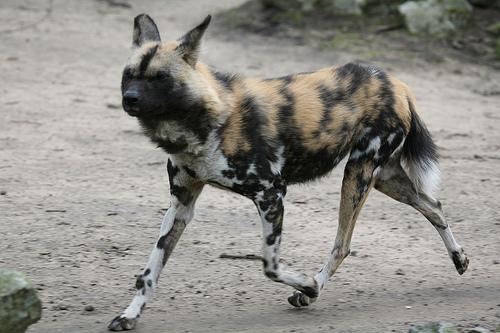
What is the African Hunting Dog?
The African Hunting Dog is a dog breed from Sub-Saharan Africa with about 66-78 cm (26-31 inches) tall, about 20-30 kg (44-66 lbs), a short, multicolored patches of yellow, black, and white coat, and a typical lifespan of 10-11 years in the wild.
Sub-Saharan Africa
10-11 years in the wild
20-30 kg (44-66 lbs)
66-78 cm (26-31 inches)
Short, multicolored patches of yellow, black, and white
Long legs, graceful skeleton, no dewclaws
What is the African Hunting Dog temperament?
African wild dogs are intensely social pack animals with remarkable intelligence and cooperative instincts.
They form tight-knit family units where they care for each other through food regurgitation—a bonding behavior that extends to all pack members, not just puppies. These dogs are highly coordinated hunters that demonstrate sophisticated communication and strategic teamwork, attacking prey with stamina-based tactics rather than raw power. Despite their fierce hunting prowess, they're surprisingly gentle with their pack, showing genuine affection and complex hierarchical relationships.
Where did the African Hunting Dog come from?
The African wild dog has been revered in ancient cultures, particularly among the San people of southern Africa and in prehistoric Egypt, where they held spiritual significance.
Scientific classification began in 1820 when Coenraad Jacob Temminck first formally described the species based on a Mozambique specimen. The genus Lycaon, derived from the Greek word for 'wolf-like,' distinguishes these dogs from other canines through their highly specialized carnivorous teeth and the unique absence of dewclaws. Today, they represent a living link to early canine evolution and are among Africa's most specialized predators.
What health and care needs does the African Hunting Dog have?
African wild dogs face severe conservation threats, with only approximately 6,600 adults remaining in 39 fragmented subpopulations worldwide.
They are highly susceptible to disease outbreaks like rabies and distemper, which can devastate entire packs. Habitat loss and human persecution pose ongoing challenges to their survival, making them critically important for biodiversity conservation efforts.
Which breeds look similar to the African Hunting Dog?
The African Hunting Dog is useful to compare with Affenpinscher, Afghan Hound, Airedale, and American Staffordshire Terrier when practicing similar breed recognition.
How hard is the African Hunting Dog to recognize in BreedGuessr?
The African Hunting Dog gets easier to recognize in BreedGuessr when players focus on its Sub-Saharan Africa origin, short, multicolored patches of yellow, black, and white coat, and 66-78 cm (26-31 inches) outline before choosing an answer.
BreedGuessr reinforces those clues with real dog photos, multiple-choice comparisons, and quick links back to breed guides before you play another round.
What makes the African Hunting Dog memorable?
A memorable African Hunting Dog fact is this: African wild dogs have the most specialized carnivorous teeth of any living canine, with premolars disproportionately large relative to their body size.
- African wild dogs have the most specialized carnivorous teeth of any living canine, with premolars disproportionately large relative to their body size.
- They lack dewclaws entirely, an adaptation that increases their stride length and running speed for pursuing prey across open savannas.
- The 'painted dog' nickname comes from their unique multicolored coat pattern—no two individuals have identical markings.
- Young dogs eat first at kills as a sign of pack privilege, and adults regurgitate meat for them as a form of social bonding.
- They hunt primarily at dawn and dusk using stamina and cooperation rather than strength, often chasing prey to exhaustion.
- Despite being the largest wild canines in Africa, lions actively hunt and kill them whenever possible.
Source: Wikipedia. Image: Wikimedia Commons (CC BY-SA 3.0)