Airedale
The King of Terriers
By BreedGuessr · Dog breed learning game maintainers · Published · Updated
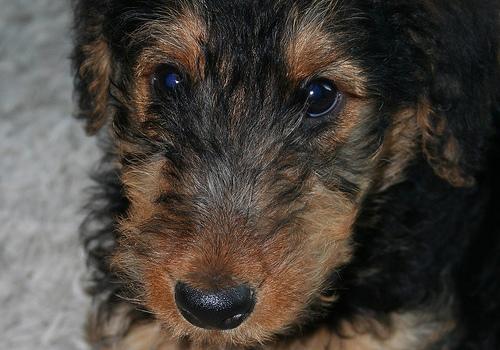
What is the Airedale?
The Airedale is a dog breed from River Aire Valley, Yorkshire, England with about 22-24 inches at withers tall, about 40-65 lbs (standard), a black and tan, wiry double coat coat, and a typical lifespan of 11-14 years.
River Aire Valley, Yorkshire, England
40-65 lbs (standard)
22-24 inches at withers
11-14 years
Black and tan, wiry double coat
Minimal (requires hand-stripping)
What is the Airedale temperament?
Airedales are alert, fearless, and energetic dogs with a no-nonsense attitude befitting their "King of Terriers" title.
They're not naturally aggressive but possess an unwavering confidence and independence that makes them excellent working dogs and family protectors. These intelligent terriers are versatile and adaptable, equally comfortable hunting game, guiding the blind, or serving in police work. Despite their working-dog heritage, they form strong bonds with their families and thrive on having a job to do—without proper outlets, their spirited nature can become destructive.
Where did the Airedale come from?
The Airedale Terrier emerged in the mid-1800s from the River Aire valley in Yorkshire, England, where they were developed by crossing Old English Black and Tan Terriers with Otterhounds to create the ultimate versatile hunting and farm dog.
Their reputation as the "King of Terriers" comes from being the largest of all terrier breeds, a distinction that earned them roles as war dogs, police dogs, and guide dogs throughout Britain and beyond. In North America, larger "Oorang" variants were developed in early 1900s Ohio, bred specifically for big game hunting and standing up to 70 pounds—a significant departure from the standard breed.
What health and care needs does the Airedale have?
Airedales are generally hardy dogs with a lifespan of 11-14 years, but larger Oorang-type Airedales are significantly more prone to hip dysplasia than their breed-standard counterparts.
Their wiry double coat requires regular maintenance through hand-stripping or clipping every 6-8 weeks, and while often marketed as hypoallergenic, scientific studies have found no significant differences in allergen levels compared to other dog breeds.
Which breeds look similar to the Airedale?
The Airedale is useful to compare with American Staffordshire Terrier, Australian Terrier, Bedlington Terrier, and Border Terrier when practicing similar breed recognition.
How hard is the Airedale to recognize in BreedGuessr?
The Airedale gets easier to recognize in BreedGuessr when players focus on its River Aire Valley, Yorkshire, England origin, black and tan, wiry double coat coat, and 22-24 inches at withers outline before choosing an answer.
BreedGuessr reinforces those clues with real dog photos, multiple-choice comparisons, and quick links back to breed guides before you play another round.
What makes the Airedale memorable?
A memorable Airedale fact is this: Airedales are sometimes called 'Oorangs' after an Ohio kennel that bred a much larger variant in the early 1900s, creating dogs up to 70 pounds—nearly double the breed standard.
- Airedales are sometimes called 'Oorangs' after an Ohio kennel that bred a much larger variant in the early 1900s, creating dogs up to 70 pounds—nearly double the breed standard.
- They were originally developed by crossing Old English Black and Tan Terriers with Otterhounds, combining two very different working dog types into one versatile breed.
- The breed's wiry coat comes from selective breeding for the 'crinkly' texture, which was historically preferred because it provided the harshest, most weather-resistant coat.
- Airedales have contributed to the development of other dog breeds, including the Yorkshire Terrier, showing their influence in terrier breed development.
- In most European countries and Australia, tail docking is now illegal unless medically necessary, leading to longer, more naturally carried tails that differ from traditional show standards.
- Hand-stripping, the traditional grooming method using a small serrated knife, is still preferred by many owners to maintain the breed's characteristic harsh coat texture.
Source: Wikipedia. Image: Wikimedia Commons (CC BY-SA 3.0)