Basenji
The Barkless African Hunter
By BreedGuessr · Dog breed learning game maintainers · Published · Updated
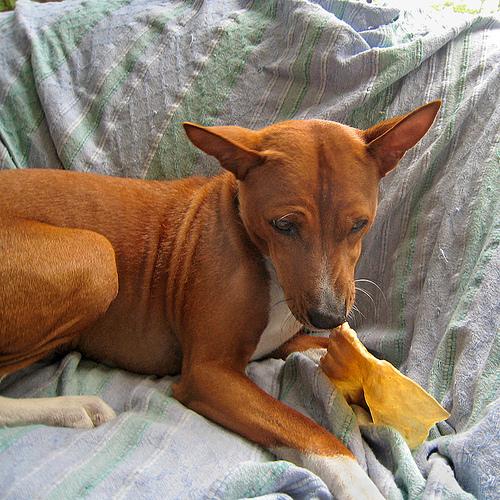
What is the Basenji?
The Basenji is a dog breed from Central Africa (Congo, Sudan) with about 16-17 inches tall, about 22-26 lbs, a short, sleek, odorless coat, and a typical lifespan of 12-16 years.
Central Africa (Congo, Sudan)
12-16 years
16-17 inches
22-26 lbs
Short, sleek, odorless
Yodel-like vocalizations instead of barking
What is the Basenji temperament?
Basenjis are spirited, intelligent hunters with curious, independent personalities.
They're remarkably clean dogs that lack the typical "dog smell" and are known for their cat-like fastidiousness. These athletic athletes are energetic and playful but require experienced owners who understand their stubborn streak and high prey drive. Their unique yodel-like "talking" makes them endlessly entertaining, though their vocalizations are far from silent despite their "barkless" nickname.
Where did the Basenji come from?
The Basenji is one of the most ancient dog breeds, identified with Egyptian Tesem dogs depicted in murals dating back 4,500 years with their characteristic curled tails and erect ears.
The breed originated in Central Africa where local peoples prized them for intelligence, courage, speed, and hunting silence. Europeans first formally described them in 1895 in the Congo, though a Basenji appeared in Queen Victoria's 1843 portrait. After initial failures introducing the breed to England in the 1920s due to disease, successful foundation stock was established in the 1930s, with the AKC officially recognizing the breed in 1943.
What health and care needs does the Basenji have?
Basenjis are generally hardy dogs with few breed-specific health issues, though they can be prone to hip dysplasia and progressive retinal atrophy.
Their unique genetics—including only two copies of the AMY2B gene like wolves and huskies—suggests they're evolutionarily distinct. Potential owners should be aware that they're particularly sensitive to certain vaccines and medications, and early imports faced devastating losses to distemper.
Which breeds look similar to the Basenji?
The Basenji is useful to compare with Affenpinscher, Afghan Hound, African Hunting Dog, and Airedale when practicing similar breed recognition.
How hard is the Basenji to recognize in BreedGuessr?
The Basenji gets easier to recognize in BreedGuessr when players focus on its Central Africa (Congo, Sudan) origin, short, sleek, odorless coat, and 16-17 inches outline before choosing an answer.
BreedGuessr reinforces those clues with real dog photos, multiple-choice comparisons, and quick links back to breed guides before you play another round.
What makes the Basenji memorable?
A memorable Basenji fact is this: The Basenji's yodel-like vocalization comes from an unusually shaped larynx, earning it the nickname 'the barkless dog,' a trait it shares only with the New Guinea singing dog.
- The Basenji's yodel-like vocalization comes from an unusually shaped larynx, earning it the nickname 'the barkless dog,' a trait it shares only with the New Guinea singing dog.
- In Swahili, 'Basenji' means 'savage dog,' while another local name 'mbwa wa mwitu' translates to 'dog that jumps up and down,' referencing their habit of leaping straight up to spot prey.
- Basenjis only come into heat once per year like dingoes and Tibetan Mastiffs, unlike most other dog breeds that may breed multiple times annually.
- DNA studies show the Basenji is a basal breed predating modern dogs, sharing an ancient lineage with the dingo and possessing the same limited amylase gene copies as wolves.
- Nearly all Basenjis in the Western world likely descend from just a handful of dogs successfully imported in the 1930s, after earlier attempts all died from distemper.
- The breed is remarkably odorless and fastidiously clean, grooming themselves like cats and lacking the typical 'dog smell' that characterizes most other breeds.
Source: Wikipedia. Image: Wikimedia Commons (CC BY-SA 3.0)