Bernese Mountain Dog
The Alpine Farm Guardian
By BreedGuessr · Dog breed learning game maintainers · Published · Updated
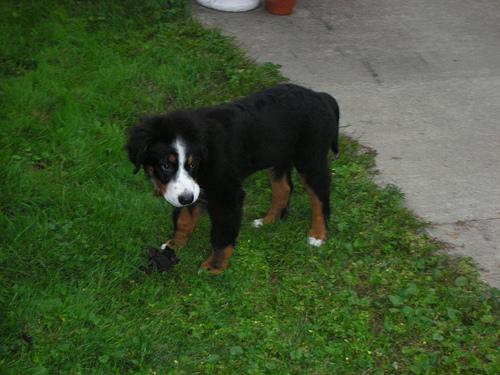
What is the Bernese Mountain Dog?
The Bernese Mountain Dog is a dog breed from Canton of Bern, Switzerland with about 25-27 inches (dogs), 23-26 inches (bitches) tall, about 80-135 lbs (dogs), 80-110 lbs (bitches), a long, dense tri-color (black, white, rust) coat, and a typical lifespan of 7-10 years.
Canton of Bern, Switzerland
7-10 years
25-27 inches (dogs), 23-26 inches (bitches)
80-135 lbs (dogs), 80-110 lbs (bitches)
Long, dense tri-color (black, white, rust)
Large, muscular, slightly longer than tall
What is the Bernese Mountain Dog temperament?
Bernese Mountain Dogs are devoted, intelligent companions with calm, patient temperaments that make them excellent family dogs.
Despite their imposing size and working heritage, they're known for their gentle, friendly nature and strong bonds with their families. These dogs are highly adaptable and eager to please, thriving both as working animals and beloved household pets. They excel at draft work and can still pull carts despite their transition to modern life. Their affectionate demeanor belies their heritage as powerful alpine guardians.
Where did the Bernese Mountain Dog come from?
Originating in the Swiss Alps, Bernese Mountain Dogs descend from Roman mastiffs and were historically called Dürrbachhunds after the small town where they were especially prevalent.
Farmers bred them as versatile workers to drive cattle, pull carts laden with milk and cheese, and guard property across alpine pastures, earning them the nickname 'Cheese Dogs.' The breed was formally established when breeders from Burgdorf founded the Schweizerischer Dürrbach-Klub in 1907, with the first breed standard written that same year. The American Kennel Club recognized the breed in 1937, and today they rank 19th in AKC popularity in the United States.
What health and care needs does the Bernese Mountain Dog have?
Bernese Mountain Dogs have a notably high cancer prevalence, with studies showing cancer responsible for approximately 55% of deaths in the breed.
Osteosarcoma, an aggressive bone marrow cancer, occurs with concerning frequency. Prospective owners should be aware of these health predispositions and seek breeders who conduct health screening. Regular veterinary care and monitoring are essential for maintaining quality of life.
Which breeds look similar to the Bernese Mountain Dog?
The Bernese Mountain Dog is useful to compare with EntleBucher, Greater Swiss Mountain Dog, Affenpinscher, and Afghan Hound when practicing similar breed recognition.
How hard is the Bernese Mountain Dog to recognize in BreedGuessr?
The Bernese Mountain Dog gets easier to recognize in BreedGuessr when players focus on its Canton of Bern, Switzerland origin, long, dense tri-color (black, white, rust) coat, and 25-27 inches (dogs), 23-26 inches (bitches) outline before choosing an answer.
BreedGuessr reinforces those clues with real dog photos, multiple-choice comparisons, and quick links back to breed guides before you play another round.
What makes the Bernese Mountain Dog memorable?
A memorable Bernese Mountain Dog fact is this: The distinctive 'Swiss cross' marking on the chest and 'Swiss kiss' white mark on the neck are breed hallmarks rooted in Swiss heritage.
- The distinctive 'Swiss cross' marking on the chest and 'Swiss kiss' white mark on the neck are breed hallmarks rooted in Swiss heritage.
- Bernese Mountain Dogs are the only Sennenhund breed with a long coat, setting them apart from their three relatives.
- A working Bernese Mountain Dog was photographed in Michigan in 1905, documenting the breed's presence in North America well before formal AKC recognition.
- The breed nearly disappeared but was revived in the early 1900s when enthusiasts exhibited them at shows in Bern.
- By 1910, just three years after the breed club's founding, there were already 107 registered members.
- These 'dry-mouthed' dogs have minimal drool, making them tidier household companions despite their large size.
Source: Wikipedia. Image: Wikimedia Commons (CC BY-SA 3.0)