Dhole
The Asian Wild Dog
By BreedGuessr · Dog breed learning game maintainers · Published · Updated
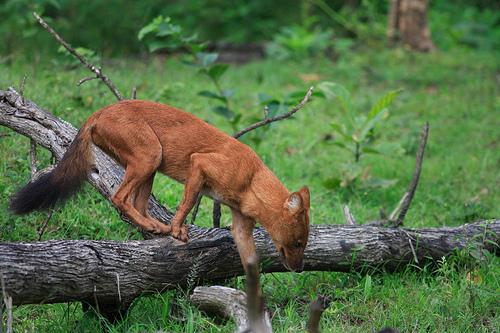
What is the Dhole?
The Dhole is a dog breed from South, East, and Southeast Asia with about 10-21 lbs (4.5-9.5 kg), a short, dense reddish-brown fur coat, and a typical lifespan of 10-12 years in the wild.
South, East, and Southeast Asia
10-12 years in the wild
10-21 lbs (4.5-9.5 kg)
Short, dense reddish-brown fur
12 individuals, up to 40+
Diurnal pack hunter of large ungulates
What is the Dhole temperament?
Dholes are intensely social animals that thrive in large, cooperative packs without rigid hierarchies—a trait unique among wild canids.
They are intelligent, coordinated hunters that work together with remarkable precision, often whistling to communicate across distances in dense forests. Despite their predatory nature, they display surprisingly gentle intra-pack dynamics, with multiple breeding females living harmoniously together. Their playful, curious disposition makes them adaptable to various environments, though they remain fiercely protective of their pack and territory.
Where did the Dhole come from?
The dhole's scientific name, Cuon alpinus, was first formally described by naturalist Peter Simon Pallas in 1811, though the species inhabited a much wider range during the Pleistocene—spanning from Europe across all of Asia.
The species became restricted to its current Asian range approximately 12,000-18,000 years ago as climate and ecosystems shifted. Paleontologist Erich Thenius's groundbreaking 1955 study traced the dhole's evolutionary origins to a golden jackal-like ancestor, establishing it as a distinct lineage separate from the genus Canis despite superficial similarities.
What health and care needs does the Dhole have?
Dholes face significant threats from disease transmission from domestic dogs, a major factor in their endangered status.
Habitat loss, prey depletion, and persecution due to livestock predation have devastated wild populations, reducing them to fewer than 2,500 mature individuals. Competition with larger predators like tigers and leopards for food resources further strains their survival in remaining tropical forest strongholds.
Which breeds look similar to the Dhole?
The Dhole is useful to compare with Affenpinscher, Afghan Hound, African Hunting Dog, and Airedale when practicing similar breed recognition.
How hard is the Dhole to recognize in BreedGuessr?
The Dhole gets easier to recognize in BreedGuessr when players focus on its South, East, and Southeast Asia origin and short, dense reddish-brown fur coat before choosing an answer.
BreedGuessr reinforces those clues with real dog photos, multiple-choice comparisons, and quick links back to breed guides before you play another round.
What makes the Dhole memorable?
A memorable Dhole fact is this: Dholes have a unique skull structure that is convex rather than concave, distinguishing them anatomically from all other wild dogs.
- Dholes have a unique skull structure that is convex rather than concave, distinguishing them anatomically from all other wild dogs.
- They lack a third lower molar and have upper molars with only a single cusp—features that make them unmistakably different from members of the genus Canis.
- The word 'dhole' was first recorded in English in 1808 by soldier Thomas Williamson, who encountered them in India and noted it was a common local name.
- Dholes communicate using distinctive whistling vocalizations, earning them the alternative name 'whistling dog' across their range.
- A single controversial fossil record suggests dholes may have briefly inhabited North America during the Pleistocene era.
- Despite being fierce pack hunters capable of taking down prey much larger than themselves, dholes maintain remarkably egalitarian social structures with multiple breeding females per pack.
Source: Wikipedia. Image: Wikimedia Commons (CC BY-SA 3.0)