Irish Setter
The Fiery Red Athlete
By BreedGuessr · Dog breed learning game maintainers · Published · Updated
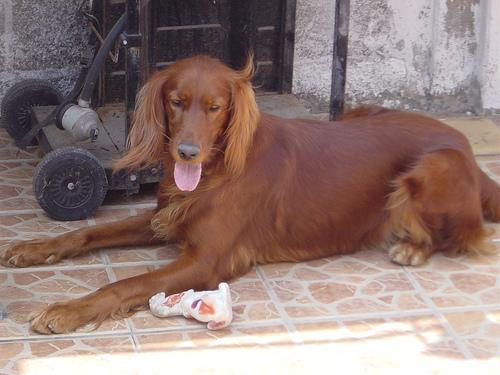
What is the Irish Setter?
The Irish Setter is a dog breed from Ireland with about males ~27 inches, females ~25 inches tall, a moderately long, silky, deep red or chestnut coat, and a typical lifespan of 11-12 years.
Ireland
11-12 years
Males ~27 inches, Females ~25 inches
Moderately long, silky, deep red or chestnut
Deep chest, small waist, athletic frame
Gundog and family companion
What is the Irish Setter temperament?
Irish Setters are the extroverts of the dog world—friendly, affectionate, and radiating joy.
They're high-energy athletes that thrive on long daily walks and off-lead running in open spaces, making them perfect for active families. Beyond their love of adventure, they have a gentle soul and are widely used as therapy dogs in schools and hospitals, where their calm presence and approachable nature help create a soothing environment. Their combination of spirited playfulness and genuine warmth makes them beloved companions.
Where did the Irish Setter come from?
The Irish Setter's story begins with early setter spaniels documented as far back as 1570 in English literature, though the modern breed is distinctly Irish.
By the 18th century, prominent Irish gentry including the de Freyne family (who began detailed stud records in 1793), Lord Clancarty, and the Marquis of Waterford actively bred their own setter lines. The breed's signature solid red coat developed through deliberate selective breeding throughout the 19th century, replacing the earlier red-and-white coloring. The official breed standard was formally established by the Irish Red Setter Club in Dublin on March 29, 1886, solidifying the Irish Setter as we know it today.
What health and care needs does the Irish Setter have?
Irish Setters generally enjoy good health with a life expectancy of 11-12 years.
Their beautiful coats require frequent brushing to prevent matting, especially the abundant undercoat in winter. Prospective owners should ensure these energetic dogs receive adequate daily exercise to maintain physical and mental well-being.
Which breeds look similar to the Irish Setter?
The Irish Setter is useful to compare with English Setter, Gordon Setter, Affenpinscher, and Afghan Hound when practicing similar breed recognition.
How hard is the Irish Setter to recognize in BreedGuessr?
The Irish Setter gets easier to recognize in BreedGuessr when players focus on its Ireland origin, moderately long, silky, deep red or chestnut coat, and males ~27 inches, females ~25 inches outline before choosing an answer.
BreedGuessr reinforces those clues with real dog photos, multiple-choice comparisons, and quick links back to breed guides before you play another round.
What makes the Irish Setter memorable?
A memorable Irish Setter fact is this: The name 'Irish Setter' literally translates to 'red setter' in Irish (Ainmneacha Plandaí is Ainmhithe).
- The name 'Irish Setter' literally translates to 'red setter' in Irish (Ainmneacha Plandaí is Ainmhithe).
- Early setters described in 1616 literature were called 'land spaniels,' showing the breed evolved from spaniel hunting dogs.
- By 1845, Irish breeders had such a strong preference for solid red coloring that it became the dominant trait in the breed.
- Irish Setters are permitted to visit hospital patients on assigned floors as certified therapy dogs with special permission.
- Their elegant feathering on the tail, ears, chest, and legs is a hallmark feature that requires regular maintenance.
- The breed's official 100-point show standard, created in 1886, helped distinguish the Irish Setter from other setter breeds.
Source: Wikipedia. Image: Wikimedia Commons (CC BY-SA 3.0)