Komondor
The Hungarian Mop Dog
By BreedGuessr · Dog breed learning game maintainers · Published · Updated
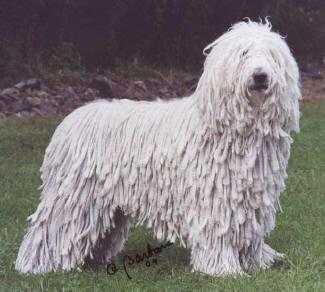
What is the Komondor?
The Komondor is a dog breed from Hungary, brought by Cumans in 12th century with about 25.5-27.5 inches (males); 23.5-26 inches (females) tall, about 80-130 lbs (males); 50-90 lbs (females), and a typical lifespan of 10-12 years.
Hungary, brought by Cumans in 12th century
10-12 years
25.5-27.5 inches (males); 23.5-26 inches (females)
80-130 lbs (males); 50-90 lbs (females)
Long, thick, heavy corded (matted)
Livestock guardian dog
What is the Komondor temperament?
Komondors are independent, intelligent livestock guardians bred to think and act on their own.
They're fiercely protective of their family and territory, making excellent watchdogs with a calm but confident demeanor. Despite their intimidating appearance, they're loyal and affectionate with those they trust, though they require experienced handlers who understand their guardian instincts. These dogs are naturally suspicious of strangers and have strong protective drives that demand proper socialization and training.
Where did the Komondor come from?
Komondors arrived in Hungary with the Cumans, a Turkic nomadic people who settled in the region during the 12th-13th centuries, fleeing Mongol expansion from Central Asia.
The breed's name derives from 'Koman-dor,' meaning 'Cuman dog,' and was first officially documented in 1544 in a Hungarian codex. Declared one of Hungary's national treasures, the breed nearly faced extinction during World War II when many were killed by German and Russian forces because they fiercely guarded farms and homes. Today, Komondors remain fairly common in their homeland and represent an important link to Hungary's medieval nomadic heritage.
What health and care needs does the Komondor have?
Komondors are generally healthy dogs with few breed-specific genetic issues.
Their unique corded coat requires significant maintenance and can harbor parasites or skin infections if not properly groomed and dried. Hip dysplasia and bloat are concerns in the breed, so responsible breeding and careful feeding practices are essential.
Which breeds look similar to the Komondor?
The Komondor is useful to compare with Affenpinscher, Afghan Hound, African Hunting Dog, and Airedale when practicing similar breed recognition.
How hard is the Komondor to recognize in BreedGuessr?
The Komondor gets easier to recognize in BreedGuessr when players focus on its Hungary, brought by Cumans in 12th century origin and 25.5-27.5 inches (males); 23.5-26 inches (females) outline before choosing an answer.
BreedGuessr reinforces those clues with real dog photos, multiple-choice comparisons, and quick links back to breed guides before you play another round.
What makes the Komondor memorable?
A memorable Komondor fact is this: Their distinctive corded coat, which develops naturally as they mature, can take 2-3 years to fully form and resembles a mop, earning them the nickname 'mop dogs.'
- Their distinctive corded coat, which develops naturally as they mature, can take 2-3 years to fully form and resembles a mop, earning them the nickname 'mop dogs.'
- Komondor remains have been found in Cuman gravesites, providing archaeological evidence of the breed's ancient origins in Hungary.
- During their guard duty evolution, Komondors developed the ability to act completely independently—they were trusted to make life-or-death decisions protecting livestock without human direction.
- The breed's white coat serves a practical purpose: it helps them blend in with white sheep flocks, allowing them to guard from within the herd undetected.
- A Komondor's corded coat is so dense that even experienced handlers struggle to bathe and dry them properly—the entire process can take days.
Source: Wikipedia. Image: Wikimedia Commons (CC BY-SA 3.0)